The record

The evidence and sources

Every entry below is a documented finding, kept for the record. This is not an exhaustive compilation, it is just the start.

Section C

What the FBI's own review board found

Source for this entire section is one document: the FBI Inspection Division memorandum recording an Aircraft Accident Review Board deliberation, file 66A-HQ-1255145, dated October 13, 2000. It was released to us on June 18, 2026, at pages 18 to 24 of a 186-page production.

The maneuver had always been practiced over flat ground, not in a canyon

“The pilots explained that in previous years, the ‘box canyon turn’ maneuver was practiced over flat terrain where imaginary canyon boundaries were established by using ground-based landmarks such as barns or other buildings. This enabled pilots to practice this type of flying while ensuring their safety by allowing space for error.”

Memorandum 66A-HQ-1255145, page 23 of 186.

Why it mattersThe stated cause treats the choice of canyon as the error. This sentence shows the board knew the maneuver was never meant to be flown in a real canyon at all. That is the difference between one instructor's misjudgment and a failure of the program that sent him up.
The aircraft was underpowered for the exercise

“the plane being utilized was underpowered for this type of exercise”

Memorandum 66A-HQ-1255145, page 24 of 186. Third of four items the board listed as playing a major part in the accident. The other three were entering a narrow canyon from which they could not escape, an instructor pilot relatively inexperienced in Colorado mountain flying, and a relatively inexperienced Bureau pilot.

Why it mattersLook at what the board's own list actually blames. The canyon is terrain. The instructor's inexperience and the Bureau pilot's inexperience are two dead men who cannot answer for themselves. Only the aircraft, the fourth item, points at a decision the Bureau itself made, and even that one did not reach the official cause. The board's internal list of what went wrong still pointed everywhere except at headquarters, the same headquarters that picked the vendor without competition and approved a course with no curriculum at all.

No curriculum, no checklists, no checks and balances

“The consensus of the investigating team members and the AARB was that the training provided by Colorado Skyways consisted of no curriculum, no checklists, no checks and balances and that training left little margin for pilot error.”

Memorandum 66A-HQ-1255145, page 23 of 186.

Why it mattersAn institutional finding, made internally, that does not appear in any public accounting of this accident.

The official who designed the course did not know a Piper had been substituted for the agreed Cessna

“advised that he was unaware that Colorado Skyways was utilizing a low wing Piper Archer in place of the agreed upon Cessna aircraft.”

“Cessna 172 planes would be utilized for the training with the provision that larger sized pilots could opt to fly a larger Cessna 182RG. The Cessna 172 was chosen in order to provide the pilots with more of a Challenge in flying the course.”

Memorandum 66A-HQ-1255145, page 21 of 186. The speaker's name is withheld under exemptions b6 and b7C. A second passage in the same production adds that he “might not have objected to the use of this airplane, provided that the pilot was allowed to complete a few touch and go patterns in the aircraft before flying into the mountains.”

Why it mattersPaul was not flying the aircraft the FBI had agreed to buy training in. The accommodation the Bureau had made for a larger pilot was a larger Cessna, not a different manufacturer's low-wing airplane. The official who set the course up learned about the substitution after the crash.

Bought on a purchase order to stay under the contract threshold, and never once inspected

“the mountain flying course provided by Colorado Skyways was obtained through Government Purchase Order (GPO) rather than contract due to the less than $25,000 cost. A GPO, unlike the conditions that would be specified in a contract, did not describe a specific course of instruction to be provided, did not set minimum instructor experience or aircraft requirements, and did not set standards of instruction, or any course completion requirements.”

“Members noted the lack of any random onsite visits by members of ASOU to ensure that the training being conducted by Colorado Skyways was adequate. Furthermore, ASOU did not oversee the training provided by Colorado Skyways to ensure that it was being conducted properly and safely.”

Memorandum 66A-HQ-1255145, pages 21 and 23 of 186. The purchase order was for $19,000, to train 25 Bureau pilots per summer. Page 21 records that it was suggested by the Aviation Program Manager of the Aviation and Special Operations Unit, and that in three years no on-site visit was conducted.

Why it mattersThis is the procurement decision that made the training failure possible. Nineteen thousand dollars, kept below the twenty-five thousand dollar line that would have forced a contract, and with it went every safety condition a contract would have imposed.

The stated cause omits every one of the findings above

“The finding of cause for the accident was that the aircraft was flown into a narrow canyon from which it could not escape and the problem was made worse by a probable down draft that existed at the time of the accident.”

Memorandum 66A-HQ-1255145, spanning pages 22 and 23 of 186.

Why it mattersThe board knew about the flat-terrain practice, the underpowered aircraft, the absent curriculum, the substituted aircraft and the missing oversight. None of it reached the sentence that states why Paul died. The gap between what the FBI recorded internally and what it stated as cause is the heart of this case.

The same institution reviewed the death and bought the training

“On 08/08/2000, the AARB met to discuss the above captioned aircraft incident. Deputy Assistant Director… Office of Inspections, Inspection Division, chaired the meeting…”

Memorandum 66A-HQ-1255145, page 21 of 186. Voting members included a Chief Inspector from the same Office of Inspections. Names withheld under b6 and b7C.

Why it mattersThe FBI reviewed an accident in which the FBI was the potentially liable party, using its own Inspection Division. Whether any independent review was ever conducted by the Department of Justice Office of the Inspector General is a separate question we have put to that office.

Section A

What the FBI admitted in 2026

Source for this section is the FBI cover letter for the third interim release of FOIPA 1572723-000, dated July 24, 2026, signed by Christina Driver, Acting Section Chief, Record/Information Dissemination Section. Every quotation below was checked against the page image, not only the machine-read text.

Responsive records were destroyed

“Records that may have been responsive to your request were destroyed. Since this material could not be reviewed, it is not known if it was responsive to your request.”

Cover letter, page 2. Cites 44 U.S.C. §§ 3301 and 3310 and 36 C.F.R. Parts 1228 and 1229.10.

Why it mattersAn admission in a signed 2026 letter, not something reconstructed from a timeline. What the letter leaves out matters as much as what it says: no destruction date, no description, no schedule number, no certificate, no authorizing official.

The Bureau's own index shows records that are not where they should be

“We were advised that the potentially responsive records were not in their expected location and could not be located after a reasonable search. Following a reasonable waiting period, another attempt was made to obtain this material. This search for the missing records also met with unsuccessful results.”

Cover letter, page 2.

Why it mattersSeparate from destruction and harder to explain. Destruction has a lawful procedure behind it. Records vanishing from their expected location, through two searches, points to a chain of custody problem instead.

Fee waiver denied, with a bar on all pending and future requests attached to $26.50

“Failure to pay for this release within thirty (30) days from the date of this letter will close any pending FBI FOIPA requests from you. Non-payment will also cause an automatic denial of any future FOIPA requests.”

Cover letter, page 1. The amount is $26.50, covering duplication of three interim releases at $11.50 each less an $8.00 credit against the first.

Why it mattersThe Bureau refused a public interest fee waiver to the widow and children of an agent killed on its own training program, and attached a permanent bar to current and future requests if we did not pay twenty-six dollars and fifty cents.

250 pages reviewed, 160 released, 90 withheld, of which only 10 are substantive

“250 pages were reviewed and 160 pages are being released.”

Cover letter, page 1. The two Deleted Page Information Sheets account for exactly 90 withheld pages: 66 on one document and 24 on the other. Eighty are marked Duplicate. Ten, at pages 19 to 24 and 28 to 31 of one sheet, are marked Referral/Direct and were sent to the National Transportation Safety Board for separate response.

Why it mattersThe FBI claims to have passed on 10 pages of significance, to the NTSB, out of the total pages denied to us.

Section D

How the records were controlled

Interview reports were lent to the safety board, recalled, and barred from redistribution

“These documents are being loaned to your agency in order to assist you in the completion of your investigation. When you no longer require these documents, it is requested that they be returned to the Federal Bureau of Investigation.”

“This document contains neither recommendations nor conclusions of the FBI. It is the property of the FBI and is loaned to your agency; it and its contents are not to be distributed outside your agency.”

FBI Phoenix to NTSB Denver, February 23, 2000, date-stamped received NTSB-DEN March 3, 2000. Enclosing FD-302 reports of re-interviews conducted January 18, 2000 of the Colorado Skyways flight instructors for Cessna C-172 N97890 and N96319.

Why it mattersA documented mechanism by which the Bureau's investigative material stayed out of public reach even after it reached the safety board. It is also a legal posture: a restrictive legend of this kind is aimed at the question of who controls a record, which is what determines whether it can be reached under the Freedom of Information Act at all.

The evidence was re-inventoried in 2008 under a different case number

Property record FD-192A, item 1C 2: “PHOTOS OF PIPER ARCHER PA 28-181” plus “FD-340 WITH NOTES.” Property acquired 01/13/2000. Date entered 05/08/2008. Case number 321D-IR-8062. Owning office, Critical Incident Response.

Third interim release, document D165004099, page 53. The original case number for this material was 66H-IR-A5346.

Why it mattersEvidence from a 1999 death was moved onto a different case file in May 2008. Renumbering is the point at which material becomes easy to lose and at which retention clocks can be restarted. It is not yet known whether the admitted destruction happened under the old number or the new one.

The released flight path map is cut off at the right margin

Caption: “PROBABLE FLIGHT PATH OF N4366D PIPER ARCHER II,” hand-drawn on a USGS topographic sheet. The printed scale reads only “SCALE 1:2” before the page edge, and the contour interval line is cut off entirely.

Third interim release, document D165004055, page 6. An X marked Crash Site sits near the 11,800 foot contour, with Hunts Peak (13,071 feet) marked to the east and the Fremont and Saguache county line running between.

Why it mattersThe scale ratio and the contour interval are precisely the two values needed to take measurements off the map. We can't tell from the page whether the clipping was careless or deliberate, and we are not asserting either.

The FBI catalogued its own investigative report, with photographs, in mid-2000

Property record item 1C 1: “FBI INVESTIGATIVE REPORT OF AIRCRAFT ACCIDENT, INCLUDING PHOTOGRAPHS, INVOLVING SA PAUL LEVEILLE (DECEASED) ON 9/1/1999.”

Third interim release, document D165004055, pages 1 and 2. Acquired 05/24/2000 from FBI Phoenix, entered 06/07/2000, case 66H-IR-A5346. A separate report cover page dated April 13, 2000 carries a handwritten distribution list.

Why it mattersContemporaneous proof that a full investigative report existed and was catalogued in mid-2000, while we were told nothing.

Section B

Who else was working this case in 1999

Two documents in the FBI's own file show activity around this crash, in its first weeks, that has never been explained to us. Both are reproduced exactly. Neither is presented as proof of anything beyond what it says.

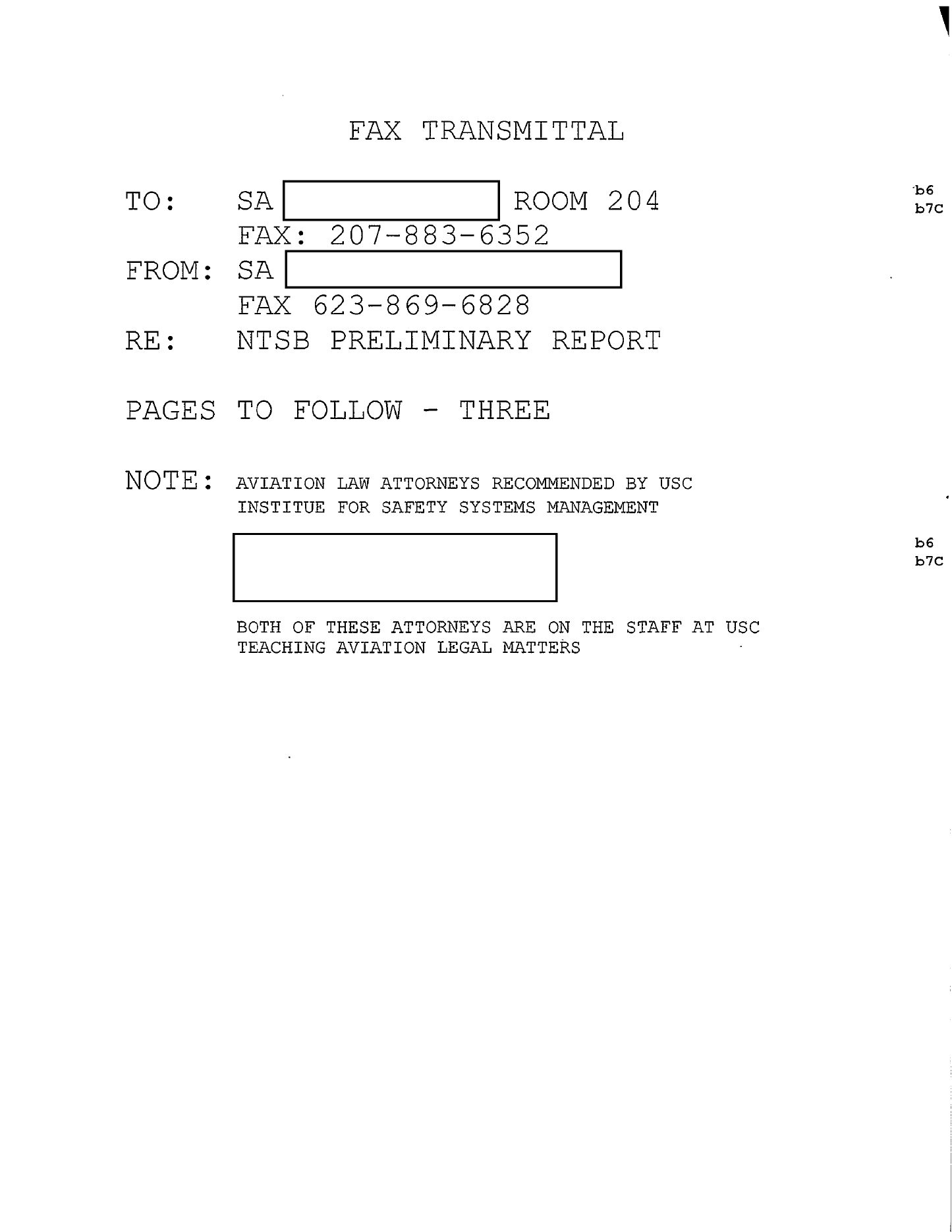
An FBI fax passing along aviation law attorneys, with both names redacted

“NOTE: AVIATION LAW ATTORNEYS RECOMMENDED BY USC INSTITUE FOR SAFETY SYSTEMS MANAGEMENT”

redacted  [withheld, b6 / b7C]

“BOTH OF THESE ATTORNEYS ARE ON THE STAFF AT USC TEACHING AVIATION LEGAL MATTERS”

Third interim release, document D165873014, page 9. Agent-to-agent fax transmittal, subject line “NTSB PRELIMINARY REPORT,” three pages to follow. The spelling “INSTITUE” is as typed on the original.

Why it mattersA contemporaneous FBI document, in the Bureau's own accident file, circulating the names of aviation lawyers in connection with this crash. The redaction block sits directly between the two typed lines, exactly where the names were. Those names are still withheld from our family.
FBI fax transmittal cover sheet. Sender and recipient agent names are blacked out. The note reads that aviation law attorneys were recommended by the USC Institute for Safety Systems Management, followed by a large redaction block, followed by a line stating both attorneys are on the staff at USC teaching aviation legal matters.
The fax, unaltered Document D165873014, page 9. Sent from a 623 number, which is the Phoenix area, to a 207 number, which is Maine. The two attorney names occupy the empty box in the middle of the page.

The fax went from Phoenix to a Maine number

“TO: SA redacted ROOM 204  FAX: 207-883-6352”
“FROM: SA redacted  FAX 623-869-6828”

Same page. Area code 623 is metropolitan Phoenix, consistent with FBI Phoenix, which ran this investigation. Area code 207 is Maine.

Why it mattersThe attorney recommendations travelled from the investigators in Phoenix to somebody in Maine. Who that was, and why they were the recipient, is not stated anywhere in the released record.

A firm of former FBI agents was working this crash within six weeks

A Freedom of Information Act request to the FAA Chief Counsel, dated October 18, 1999, on letterhead reading “Investigations by Former Special Agents of the FBI,” 1 Lone Circle Suite G, San Antonio, Texas 78258-6412.

It asks for Charles Burns' pilot logbook, Colorado Skyways' Part 141 certificate application, any Letters of Investigation issued to Burns or to Colorado Skyways, enforcement action records, Airworthiness Directives, witness statements, the assigned FAA inspectors, photographs, and the aircraft and powerplant logbooks.

Third interim release, document D165873014, pages 10 to 12.

Why it mattersSomebody was working this case professionally, six weeks after the crash, and asking for precisely the documents that would establish the vendor's fitness. The request does not say who retained them.

Section E

The physical record

A paper clip was photographed inside the engine oil sump

Item 71 on the Lycoming Air Safety Investigation mishap photo log: “The paper clip found in the oil sump.”

Third interim release, document D165004055, page 4. Engine model O-360-A4M, serial L-27490-36A. The log runs to 103 numbered photographs of a full engine teardown.

Why it mattersA foreign object inside a lubrication system is not a normal finding. Its significance here is unknown and is not being guessed at.

The engine was examined on October 20, 1999 at Beegles Aircraft, Greeley, Colorado

Photo log headed “PA-28-181 28-8490088 / 99090102 N4366D Villa Grove, CO,” in two sets: “On Scene General Wreckage Photographs; September 2, 1999” and “Engine Examination Photographs; October 20, 1999,” the engine “as first viewed at the facilities of Beegles Aircraft, Greeley, CO.”

Third interim release, document D165004055, pages 40 and 41.

Why it mattersEstablishes the teardown date and location and identifies a third party that may hold its own records of the examination.

The photo captions place the aircraft inside a canyon and record a post-impact fire

“View looking in the direction the aircraft came from in the canyon.”

“View of the canyon area as seen from the accident site.”

“The inboard right wing was destroyed by fire.”

Third interim release, document D165004055, page 40, captions 8, 9 and 33.

Why it mattersIndependent confirmation in the photographic record of the canyon setting. Pair this with the earlier finding: the photographs show the canyon, and the review board says the maneuver was never meant to be flown in one.

Section F

The federal rules the same record shows were broken

Nothing here is a new fact. Each entry rests on findings already quoted above. This is which specific federal rules those findings put the Bureau on the wrong side of.

Seven federal acquisition rules, broken by never competing the contract

The Federal Acquisition Regulation requires a contracting officer to promote competition to the maximum extent practicable (FAR 13.003(b), 13.104), to solicit sources that reasonably appear capable of doing the work (13.106-1(a)), to seek quotes from at least two sources (13.106-1(b)(2)), to document a price reasonableness determination when there is no competition (13.106-3(a)(2)), to perform quality assurance inspection (46.103), and to document an acquisition plan (7.102).

This matches a single vendor considered, no competing quotes sought, no price comparison, no acquisition plan on file, and no on-site inspection in three years.

Why it mattersThese are not close calls. Each of the six requires a specific document, a solicitation, a quote, a price comparison, a plan, that the finding above already shows never existed.

The federal safety-program statutes the Bureau owed its own agent

Federal agencies are required by 29 CFR Part 1960, Executive Order 12196, and 29 U.S.C. § 668 to maintain an effective occupational safety and health program for their own employees, including furnishing places and conditions of employment free from recognized hazards likely to cause death or serious harm.

Matched against the finding of no curriculum, no checklists, no checks and balances, and the finding of no competitive process, no oversight visits in three years. Separately, the Bureau's Director of Flight Training stated in his FD-302 that he asked twice to personally inspect this training and was refused both times by his supervisor, once on a return trip he was already making through the area. His supervisor's later account disputes that any refusal happened.

Why it mattersA federal agency has a specific duty to keep its workplace free of recognized hazards. No curriculum and no outside inspection for three years is not a hazard the Bureau failed to notice. Its own paperwork shows the Director of Flight Training tried to check on it and says he was told not to.

Section G

The same instructor, the same maneuver, weeks before Paul died

Another trainee failed the same canyon maneuver, and still could not explain it after Burns demonstrated it himself

“BURNS talked [the trainee] through a second maneuver which had not been briefed the day before... [the trainee] stated that the maneuver confused him and failed to work as it should have, so he requested BURNS demonstrate the maneuver correctly. BURNS then took control of the aircraft and re-entered the box canyon where he performed the maneuver successfully. Although the maneuver worked for BURNS and not for [the trainee], he was unable to accurately describe exactly what was involved in the maneuver or how it could have worked... but somehow it worked for BURNS despite his failure to understand precisely what was happening.”

FD-302, case 66H-IR-A5346, interview conducted 10/04/99, pages 27 and 28 of the 186-page production. The trainee's name is withheld under exemptions b6 and b7C. Log book entries elsewhere in the same production date this flight to August 18 or August 25, 1999, in the Piper Archer, one to two weeks before Paul died. The first maneuver's exit from the canyon is recorded at 100 to 200 feet above ground level.

Why it mattersThis was not one bad afternoon. Another trainee, flying the same kind of aircraft through the same kind of canyon weeks before Paul died, also failed this exact maneuver and was left unable to explain how it worked. That account was already in the Bureau's file. Nobody who could have grounded this instruction ever went and looked.

The FBI's own investigation says Burns' teaching method itself broke the rule the FAA sets for instructors

“The teaching techniques that the Flight Instructor Mr. Burns was known to have utilized were contrary to accepted practices which the Federal Aviation Administration expects Certified Flight Instructors to utilize. FAA Publication AC-60-14, Aviation Instructor's Handbook, clearly requires that an instructor demonstrate a maneuver prior to the student performing the same maneuver.”

The handbook itself, a copy of which sits in the same file: “the instructor should identify the most important learning outcomes; next, explain and demonstrate the steps involved in performing the skill being taught; and finally, allow the students time to practice each step.”

FD-204 investigative report, case 66H-IR-A5346, dated January 11, 2000, Finding 17, page 38 of the 186-page production. The AC 60-14 excerpt is at page 141, filed as exhibit item 21 in the same report.

Why it mattersThis is the FBI's investigators, citing the FAA's own publication by name, stating plainly that Burns skipped the step the method requires. Like the aircraft, like the practice of flying in an actual canyon, this finding did not reach the sentence that states why Paul died.

Another Colorado Skyways instructor did this same training safely, by doing what Burns skipped

“[He] always demonstrates a maneuver to his student before permitting the student to repeat his actions on his own. For box canyon turnouts, he will select a wide canyon and complete the demonstration maneuver at relatively high altitude for the student and then back out to the valley and use an open area with a simulated box canyon as the area for the student to practice in… Although less realistic than accomplishing the maneuver in an actual box canyon, it is also a safer course of action.”

The same instructor, asked how he judges a completed turn: “if the student is able to successfully reverse course with a minimal amount of altitude loss he considers the maneuver to have been properly flown… the criteria is that a life be saved and not that a precise maneuver be flown.”

FD-204 investigative report, case 66H-IR-A5346, interview conducted 01/11/00, pages 30 and 31 of the 186-page production. The instructor's name is withheld under exemptions b6 and b7C.

Why it mattersA colleague at the same school, teaching the same maneuver, demonstrated first and practiced the risk out of an actual canyon before ever putting a student inside one. That was available, known, and in use at Colorado Skyways at the same time Burns was doing the opposite. Even by this instructor's own loose standard, survival rather than a correct maneuver, Paul's flight still failed.

The Piper Archer had flown this exact training before, and a Cessna 182 was doing the same exercise four days before the crash

Asked to check his log book for flights “in the same basic valley area where BURNS and LEVEILLE had their accident” in the week before the crash, the same instructor “was able to state that on August 25, 1999 he flew 7.7 hours with SA [redacted] in a Cessna 182 and that they had been in the vicinity of the accident site during that day. Additionally, [he] flew 7.1 hours in the Piper Archer on August 18, 1999, with SA [redacted].”

FD-204 investigative report, case 66H-IR-A5346, page 30 of the 186-page production.

Why it mattersThe Piper Archer was not new to this training, and it was not the only aircraft available for it. A Cessna 182 was flying this identical exercise in the identical area four days before Paul died. Nothing in what we hold says whether that Piper Archer flight on August 18, or any other flight before September 1, went as intended.

A colleague's measurement: the canyon was too narrow, and he would not have used it

Another Colorado Skyways instructor, a civil engineer, hiked to the crash site and calculated that “the box canyon selected by BURNS for his practice turnout was only approximately three quarters of a mile wide and that this was way too narrow to have been able to successfully complete such a maneuver.” He “himself has looked at the canyon from the air and likewise concluded that he would not have used that particular canyon for his box canyon practice.”

FD-204 investigative report, case 66H-IR-A5346, page 30 of the 186-page production.

Why it mattersNot a hindsight judgment from an outsider. A working mountain flight instructor at the same school, using his own measurements, saying he would never have chosen that canyon.

Section H

The oversight that never happened, and the argument about why

Anthony Kruczynski was the FBI's own Director of Flight Training, the official who set up the Colorado Skyways course. His account and his supervisor's account of what happened next do not agree.

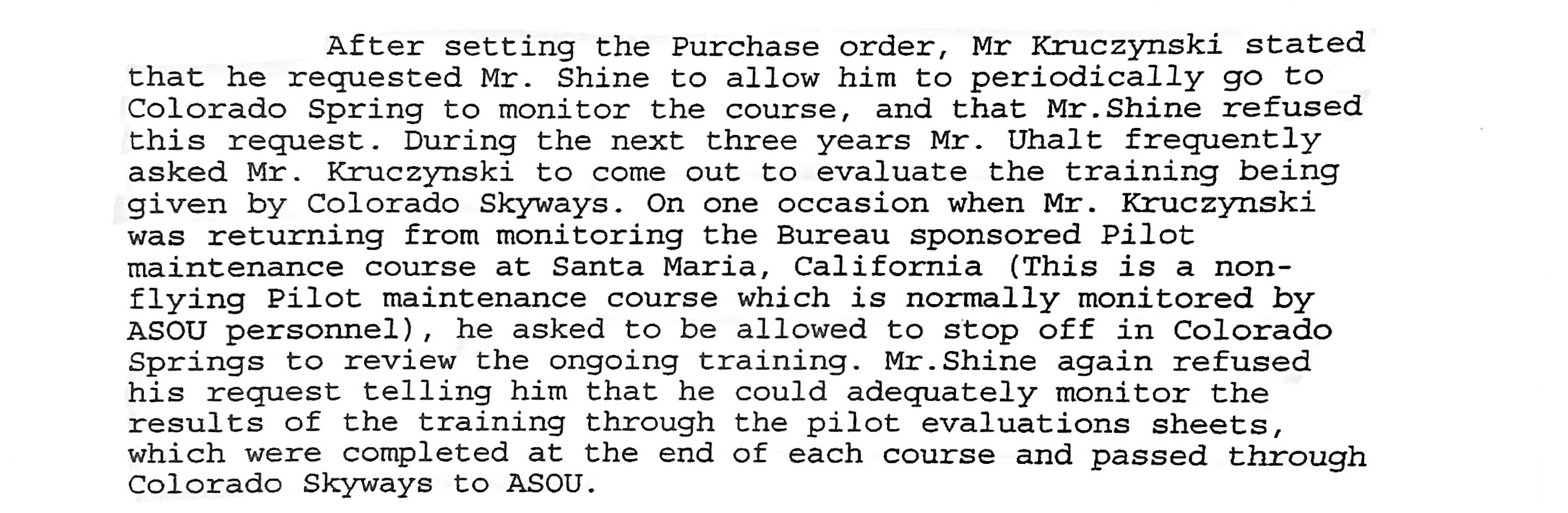
Kruczynski says he asked to inspect the training twice, and was refused both times

“After setting the Purchase order, Mr Kruczynski stated that he requested Mr. Shine to allow him to periodically go to Colorado Spring to monitor the course, and that Mr.Shine refused this request. During the next three years Mr. Uhalt frequently asked Mr. Kruczynski to come out to evaluate the training being given by Colorado Skyways. On one occasion when Mr. Kruczynski was returning from monitoring the Bureau sponsored Pilot maintenance course at Santa Maria, California (This is a non-flying Pilot maintenance course which is normally monitored by ASOU personnel), he asked to be allowed to stop off in Colorado Springs to review the ongoing training. Mr.Shine again refused his request telling him that he could adequately monitor the results of the training through the pilot evaluations sheets, which were completed at the end of each course and passed through Colorado Skyways to ASOU.”

FD-302, case 66H-IR-A5346, interview of Anthony Kruczynski, 09/23/1999. “Colorado Spring” in the first sentence is typed that way in the original.

Why it mattersThe official the Bureau put in charge of this course says he tried to inspect it, twice, over three years, and was told no both times, once on a trip that would have cost nothing extra since he was already driving back through the area. That is a direct answer to why nobody from ASOU ever visited Colorado Skyways.
Typewritten excerpt from Anthony Kruczynski's FD-302 interview describing his two requests to inspect the Colorado Skyways training and Supervisory Special Agent Shine's refusal of both.
Kruczynski's FD-302, excerpt Case 66H-IR-A5346, interview of 09/23/1999.

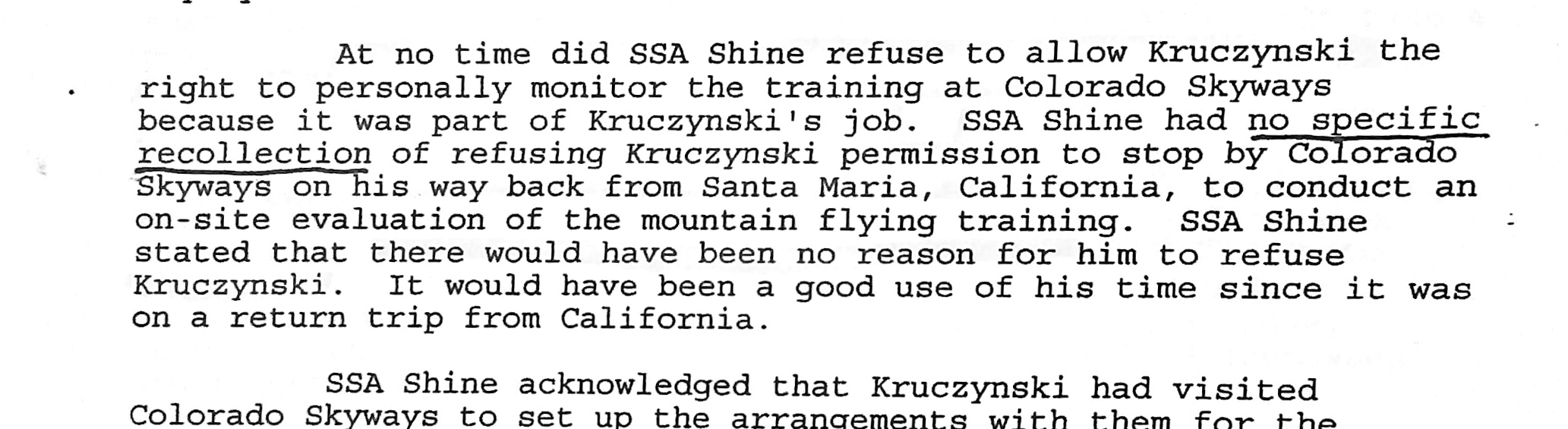
Shine, interviewed eight months later, says he never refused him

“At no time did SSA Shine refuse to allow Kruczynski the right to personally monitor the training at Colorado Skyways because it was part of Kruczynski's job. SSA Shine had no specific recollection of refusing Kruczynski permission to stop by Colorado Skyways on his way back from Santa Maria, California, to conduct an on-site evaluation of the mountain flying training. SSA Shine stated that there would have been no reason for him to refuse Kruczynski. It would have been a good use of his time since it was on a return trip from California.”

FD-302, case 66H-IR-A5346, interview of SSA James Shine, 07/17/2000.

Why it mattersTwo men gave conflicting accounts of the same trip back from California and the same request. One says he was refused. The other says it never happened and there would have been no reason to refuse. Both statements are in the Bureau's file. They cannot both be true.
Typewritten excerpt from SSA James Shine's FD-302 interview stating he never refused Kruczynski permission to monitor the training and had no reason to.
Shine's FD-302, excerpt Case 66H-IR-A5346, interview of 07/17/2000.

Section I

What the FBI's own investigative report found, and never made public

Source for this section is the FD-204 investigative report, case 66H-IR-A5346, dated January 11, 2000, a separate document from the AARB memorandum quoted in Section C. It was released to us on June 18, 2026, at pages 34 to 38 of the 186-page production, and carries its own numbered findings, distinct from the board's later, shorter finding of cause.

The FBI's investigators found that Paul had little or no experience in the aircraft he was forced to fly

“SA Leveille had little, and most likely no experience in flying this particular type of aircraft.”

FD-204 investigative report, case 66H-IR-A5346, Finding 8, page 37 of the 186-page production.

Why it mattersIn a numbered finding, the FBI's investigators admit that Paul had little to no experience in the exact aircraft the vendor substituted without authorization. That finding never reached the published cause.

Burns entered the canyon from the wrong side for the actual wind that day

“Mr. Burns entered this canyon in the wrong direction based on the prevailing winds at the time of the accident. Proper mountain flying techniques required that the aircraft should have entered the canyon away from the wind from the North side... While the winds in this area are normally from the Southwest during this time of year, weather reports and testimony from the U.S. West Helicopter pilot indicated that the winds were from the Southeast. By entering the canyon on the South side, Mr. Burns exposed the aircraft to a more significant down draft factor.”

FD-204 investigative report, case 66H-IR-A5346, Associated Causal Factors, page 36 of the 186-page production.

Why it mattersThe winds that day were not the normal pattern for the season, and Burns entered from the side that made the downdraft worse, not better. The board's later finding of cause mentions a probable downdraft. It does not mention that the instructor's own approach chose the side of the canyon that made it worse.

The vendor never even asked permission to use this aircraft

“The vendor did not seek authorization from ASOU to use this particular type of aircraft for this course of instruction.”

FD-204 investigative report, case 66H-IR-A5346, Finding 20, page 38 of the 186-page production.

Why it mattersThe finding above already shows the Bureau's own official did not know the aircraft had been swapped. This finding goes one step further: Colorado Skyways never asked. There was no request to approve, let alone a decision to approve one.

Other causes were ruled out

“There was no indication of any type of engine malfunction... There was no indication of any type of aircraft breakup or control malfunction prior to impact... There were no Air Traffic Control (ATC) factors involved with this accident... There was no indication of fuel starvation or other fuel problems... There is no indication that the aircraft was being operated in an overweight condition, or outside of its normal Center of Gravity (CG) range.”

FD-204 investigative report, case 66H-IR-A5346, Findings 11 through 15, pages 37 to 38 of the 186-page production. The same findings state drug and alcohol screens were negative for both pilots and that no behavioral or medical factor was found.

Why it mattersThe FBI's own investigators checked the aircraft, the pilots, the equipment, and the airspace, and cleared all of it. What was left, an inexperienced instructor, an inexperienced student pilot, a substituted aircraft nobody approved, and no curriculum, is exactly what the program was supposed to prevent.

Burns himself had never flown mountains before Colorado Skyways

“The Flight Instructor, Mr. Burns was fairly inexperienced for giving this type of instruction in a very hostile environment with aircraft that were being operated at the limit of their performance capabilities... Before starting his employment with Colorado Skyways, all of his flight experience is reported to have taken place in Southern California.”

FD-204 investigative report, case 66H-IR-A5346, Finding 22, page 38 of the 186-page production. The same passage describes Burns as characterized by students and fellow instructors as cautious, and notes he routinely flew higher than the other aircraft on these training flights.

Why it mattersThis isn't written to blame Burns personally. The Bureau's investigators describe a cautious instructor with no mountain background before this job, put in charge of teaching a maneuver at the edge of his aircraft's performance, in a program with no curriculum and no oversight. Both pilots were failed by the same decision to buy this training the way it was bought.

The routine findings: everyone was where they were supposed to be, doing what they were authorized to do

“The flight was authorized and approved. SA Leveille was in current flight status. SA Leveille was on duty at the time of the accident. SA Leveille held a current medical certificate. The flight Instructor Mr. Burns was current and qualified in the aircraft to act as Pilot-in-Command. Drug/Alcohol screens were negative for both pilots.”

FD-204 investigative report, case 66H-IR-A5346, Findings 1 through 6, page 37 of the 186-page production.

Why it mattersSix findings, and every one of them rules out an excuse the FBI could have used instead. Paul was authorized, current, on duty, medically cleared, sober. Burns was current and qualified. Nothing here explains the crash. What does is everything else in this section.

The FBI's investigators found the area Burns picked was unsafe

“The PIC Mr. Burns selected an area to perform the maneuver which lead to the accident that was unsuitable and unsafe.”

FD-204 investigative report, case 66H-IR-A5346, Finding 7, page 37 of the 186-page production.

Why it mattersThis training should have been inspected and the training curriculum and procedures should have been established and reviewed before any student was placed in harm's way. Basic safety measures were not taken.

A possible factor nobody has mentioned since: sun glare into the windshield

“One Environmental factor that may have played an unknown role in the Crash was the possibility of bright sunlight shining over the ridge line into the aircraft's windshield as the aircraft began the ‘Box Canyon Turn’ maneuver.”

FD-204 investigative report, case 66H-IR-A5346, Finding 10, page 37 of the 186-page production.

Why it mattersListed as a finding and never raised again anywhere in what has been released. Its significance was never established, one way or the other, and it was never followed up on.

Section J

Burns' own explanation for the aircraft swap

Source is the FD-302 interview of a second Special Agent on the same training course, conducted September 3, 1999, case 66H-IR-A5346, page 39 of the 186-page production.

Burns told the group it was about size, not performance

“When they arrived and met their flight instructors, SA Leveille's Flight Instructor, Chuck Burns, stated that because of Paul's size, they would be flying the Piper Archer as it was a bigger airplane.”

FD-302, case 66H-IR-A5346, interview of a fellow Special Agent on the course, conducted 09/03/1999, page 39.

Why it mattersThe FBI told our family privately that Paul chose the Archer himself, for legroom. This is the opposite, in the Bureau's own file: Burns, the instructor, made the call, announced it to the group as his own decision, and framed it as being about size, not performance. A fellow agent standing right there heard him say it.

The aircraft the FBI actually flew, run against the one it assigned

Everything above this section is quoted from a document or checked against a published source. This section is different, and we are saying so plainly: it is our own modeling, run 1,000 times per aircraft, using the FBI's own stated numbers wherever the FBI stated them and standard aerodynamic formulas everywhere else. Full assumptions are listed at the end so anyone, including a critic, can check them.

The Piper Archer succeeded 64.7% of the time. The Cessna 182 succeeded 95.6% of the time.

Piper PA-28-181 Archer (the aircraft Paul flew): 64.7% success, net vertical rate -926 ft/min.
Cessna 172 Skyhawk: 89.5% success, net vertical rate -830 ft/min.
Cessna 182 Skylane (the aircraft originally assigned): 95.6% success, net vertical rate -567 ft/min.

1,000 Monte Carlo iterations per aircraft. Full methodology and inputs below.

Why it mattersSame instructor, same canyon, same maneuver, same day. The only thing that changed between a 95.6% chance of walking away and a 64.7% chance is which aircraft the vendor put Paul in, a decision the record already shows nobody at the FBI approved and nobody at Colorado Skyways asked permission for.

The Archer's failures were almost entirely about climbing, not turning

All three aircraft could physically fit the turn radius inside the canyon. The Archer's 35.3% failure rate was overwhelmingly a vertical problem: modeled altitude loss during the turn, roughly 250 to 450 feet, against roughly 300 feet of terrain clearance actually available. The Cessna 182's 4.4% failure rate was almost entirely the opposite, occasional turn-radius edge cases at higher airspeed, with the aircraft still climbing throughout.

Modeled using standard turn-radius and climb-rate-degradation formulas.

Why it mattersThis is not a story about a pilot cutting a turn too tight. It is a story about an aircraft that could no longer climb at all if it was subjected to the downdrafts the FBI claims were present. A vehicle not capable of the maneuver necessary to save the pilots' lives.

Every input we used, so it can be checked

Field elevation 11,800 ft. Density altitude 15,500 ft. Downdraft strength of 700 ft/min, randomized ±200 ft/min across runs. Canyon width approximately 2,500 ft, randomized ±300 ft. Bank angle 40 to 55 degrees. Flap use, a 70% probability. Pilot reaction delay of 1 to 4 seconds. Aircraft performance figures (service ceiling, climb rate, stall speed) drawn from published specifications for each aircraft type, degraded with altitude using standard formulas.